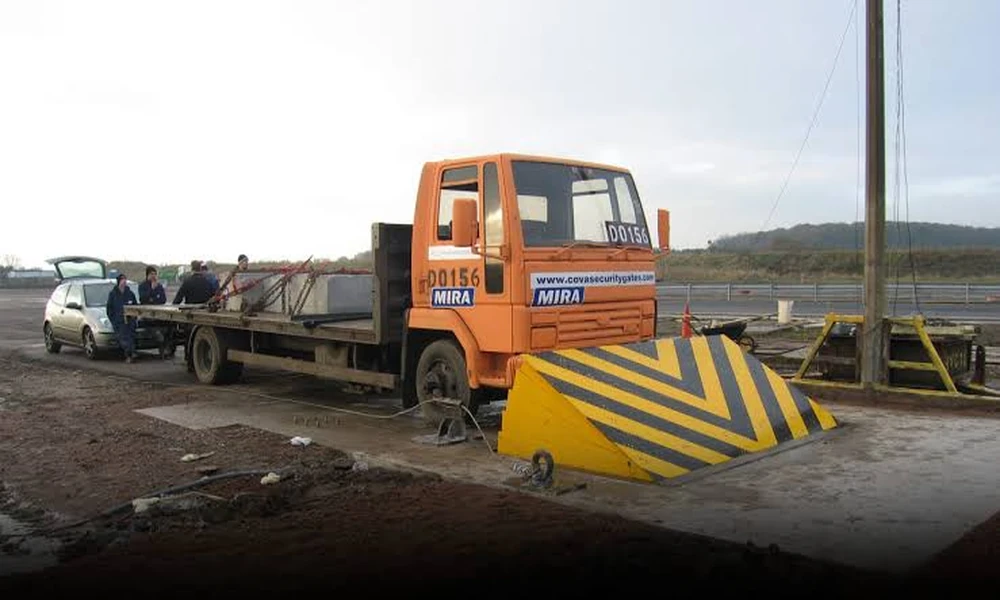
A loading dock, a drop-off lane and an open plaza all look harmless until a risk assessment flags them as vehicle access points close to an occupied building. Once that happens, the next question is almost always the same: what kind of barrier actually stops a vehicle, and how is that measured. The answer sits inside two testing standards most facility managers have heard of but never had explained: PAS 68 and IWA 14-1.
Key Takeaways
- PAS 68 and IWA 14-1 both test how a barrier performs against a specific vehicle weight, speed and approach angle, then rate how far the vehicle travels past the line.
- Binns Canada’s hostile vehicle mitigation range includes bollards, road blockers, barriers and gates rated to these standards, including products such as Truckstopper and Carstopper.
- A barrier described only as “crash-rated” tells a specifier almost nothing; the vehicle class and speed it was tested against are what actually matter.
- The practical next step: match the rating to the site’s actual risk assessment before the barrier goes into a site plan, not after.
What Do These Standards Actually Measure?
PAS 68 and IWA 14-1 test the same basic question in slightly different ways: how a barrier performs when a specific vehicle hits it at a specific speed and angle. The result is expressed as a rating covering three things: the vehicle’s weight class, its approach speed, and how far it penetrates past the barrier line after impact.
Binns Canada’s vehicle barrier systems, including bollards, road blockers and automated barriers sold under names like Truckstopper and Carstopper, are tested and rated to exactly this kind of standard. A barrier rated for a small passenger car at low speed is a different product from one rated for a loaded truck at highway speed, even if both carry a hostile vehicle mitigation (HVM) label. Specifying above what the risk assessment actually calls for is not a safety margin so much as an unnecessary cost, since a higher rating usually means a deeper foundation and a larger clear zone than the site needs.
Why Do Two Different Standards Exist?
PAS 68 came first, developed in the United Kingdom and adopted widely across Commonwealth markets, including Canada. IWA 14-1 followed as an international workshop agreement, built to bring more countries onto a shared testing method rather than each running its own. In practice, a specifier working on a Canadian project may see either standard referenced, sometimes both on the same product, and the two are broadly comparable rather than competing.
Sites Where Vehicle-Borne Threats Are a Real Design Consideration
Vehicle-borne threats are a real design consideration anywhere a vehicle can reach close to an occupied building or a crowd:
- Data centres and critical infrastructure
- Government and defence sites
- Transit hubs and transportation infrastructure
- Correctional facilities
- Stadiums, arenas and other high-occupancy venues
- Commercial and mixed-use developments with public-facing plazas or drop-off zones
Not every site on that list needs the same rating. A drop-off lane 20 metres from an entrance calls for a different speed rating than a loading dock at the back of the same building, and a risk assessment carried out early is what actually sets that number, rather than a generic industry default.
What Should a Facility Manager Ask Before Specifying a Barrier?
A handful of questions, asked before a barrier gets written into a site plan, catch most of the expensive mismatches:
- What vehicle weight class and approach speed does the site’s own risk assessment call for?
- Is the product certified to PAS 68, IWA 14-1, or both, and against which specific rating?
- Does the foundation depth the rating requires fit the site’s existing utilities and grading?
- Who installs and maintains the barrier, and are they trained on that specific product?
On that last point, Binns Canada does not install its own hardware directly; delivery runs through a network of contractors the company trains, which is worth confirming with any supplier before a schedule gets set.
Fencing and Barriers Solve Different Problems
It is worth separating this from anti-climb fencing, which is rated under a different standard, LPS 1175, and addresses forced entry by people rather than vehicles. Many sites need both working together at different points on the perimeter: fencing along the boundary, barriers at the vehicle access points. Treating them as one line item tends to under-spec one or the other.
Get the Rating Right Before the Site Plan Is Final
The mistake worth avoiding is specifying “a crash-rated barrier” as a placeholder and sorting out the actual number later. By the time a foundation is poured to the wrong depth, the fix costs far more than the barrier itself, and the delay tends to land on whichever trade is on site that week.
Binns Canada Ltd works with facility managers and specifiers across Canada and the United States to match a hostile vehicle mitigation rating to what a site’s risk assessment actually requires, before that number gets locked into concrete rather than after.