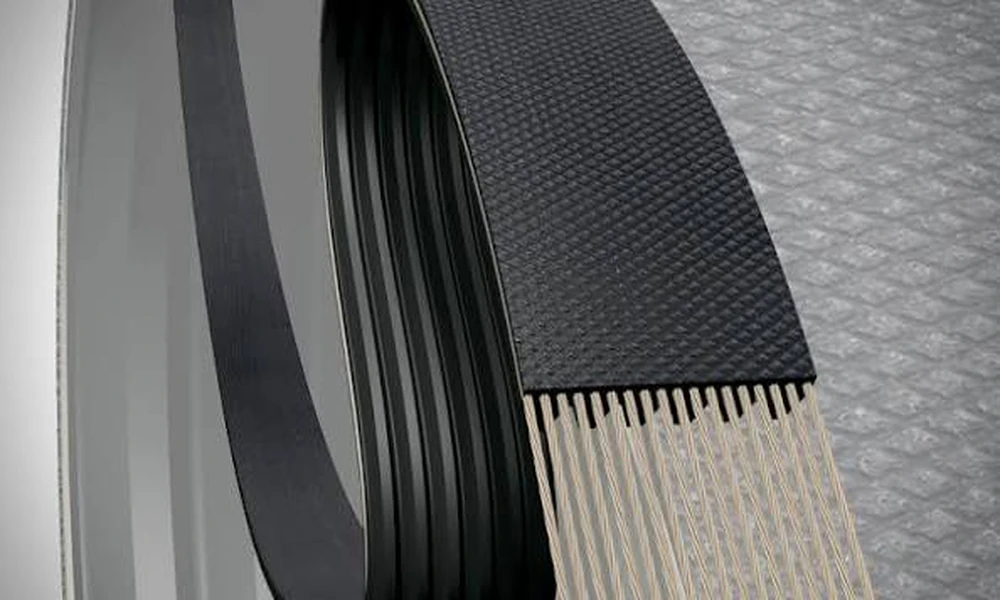
Look under the bonnet of most modern cars, or behind the drum of a washing machine, and you will find the same thing: a thin, flat belt with fine ribs running along its inner face. That is a Poly V belt, also called a V-ribbed or multi-rib belt, and it has quietly taken over many jobs that once needed a row of separate wedge belts.
In factories, the appeal is efficiency. One ribbed belt can replace a matched set, run on smaller pulleys, and turn at higher speeds with less heat. Getting those gains depends on choosing the right profile, rib count, and length, which is where knowledgeable Poly V belt suppliers earn their place. The advice that comes with a good supply often decides whether a drive runs smoothly for years or starts squealing within weeks.
What Makes a Poly V Belt Different from a Classical V Belt?
A classical V belt is a thick wedge that grips by pressing its sides into the pulley groove. It is tough and forgiving, but its bulk resists bending, so it needs fairly large pulleys and builds heat when flexed quickly. Big loads often call for several belts side by side, and those belts must be length-matched so that each one shares the work evenly.
A Poly V belt drive works differently. Its ribs are shallow, and the body is thin, so it wraps around small pulleys easily and runs at high speeds with less bending loss. Because all the ribs sit on one belt, the load spreads across the full width with no matching to worry about. The flat back can also drive or idle off a pulley, allowing serpentine layouts where one belt turns several shafts.
Which Rib Profiles Are Used in Industrial Drives?
Rib profiles are standardized in ISO 9982 under five letter codes, each with a set rib pitch, meaning the distance between neighboring ribs. Poly V belt manufacturers build to these codes so that a belt and pulley of the same profile fit together wherever each was made:
- PH: the finest rib, at about 1.6 mm pitch, found in compact and lightly loaded drives.
- PJ: a 2.34 mm pitch common in washing machines, power tools and fitness equipment.
- PK: a 3.56 mm pitch familiar to car accessory drives and medium-duty machinery.
- PL: a 4.7 mm pitch suited to heavier industrial drives such as compressors and machine tools.
- PM: the largest rib, at 9.4 mm pitch, reserved for very high power, such as crushers and large mills.
Belt width comes from the number of ribs, so a single profile can carry a little power or a great deal. Picking the profile and rib count from the motor power, shaft speeds and smallest pulley diameter is the first job in designing any Poly V belt drive, and it is where a careful sizing check pays off before a single part is ordered.
How Do Poly V Belt Suppliers Help Match a Belt to the Job?
Sizing is only part of the picture. Experienced Poly V belt suppliers also ask about the working environment: ambient heat, oil mist, dust, moisture and whether the machine starts under heavy load. Belts come in different compounds, with EPDM now widely used for its resistance to heat and ageing, and cord materials such as polyester or aramid change how much the belt stretches in service. Matching these details to the machine prevents early cracking and slipping.
Good Poly V belt suppliers help with stock planning. Keeping the right lengths on hand for critical machines, recording which belt fits which drive and flagging when an older construction is being replaced by a newer one all reduce unplanned downtime. For a maintenance team looking after dozens of machines, that organized support often matters as much as the belt itself.
Why Do Tension and Alignment Matter So Much for Ribbed Belts?
A ribbed belt grips through many small wedge surfaces, so it needs enough tension to keep every rib seated. Too little, and the Poly V belt slips under load, squeals on start-up and glazes at its ribs. Too much, bearings and shafts take a beating while the cords stretch early. Following the tension values published by Poly V belt manufacturers, then rechecking after a short running-in period, keeps the drive at its intended efficiency.
Alignment deserves the same attention. A classical V belt shrugs off small angle errors, yet a ribbed belt tolerates far less, because its ribs can climb out of their grooves and ride on the pulley lands. The warning signs are noise, fraying along one edge and uneven rib wear. A straightedge or laser alignment tool after any motor move or bearing change keeps the belt tracking true.
Where Does a Poly V Belt Drive Save Energy and Space?
The thin section bends with less internal friction than a heavy wedge, so less of the motor power turns into heat. That benefit shows most drives that run long hours, such as fans, pumps, compressors, and conveyors. A single compact Poly V belt drive can also fit where a bank of wedge belts would not, letting designers shrink guards, shafts and frames.
Speed ratio is another strength. Because the belt runs happily on small pulleys, high ratios are possible in one stage, which suits machine tool spindles, centrifuges and farm equipment. When converting an older machine from a V belt set, both pulleys have to change, since the grooves are completely different, so the switch works best during a planned overhaul.
Can a Poly V Belt Drive Replace a Set of Classical V Belts?
In many cases it can, provided the pulleys are changed and the profile and rib count are sized for the power, speed and shaft distance involved. Heavy shock loads and very long centre distances may still favour classical belts, so the answer depends on the machine. Before converting, gather the motor rating, speeds, pulley sizes and operating conditions, and compare options with Poly V belt suppliers who can check the calculation. With the right profile, correct tension and true alignment, a ribbed drive delivers smooth and efficient power transmission over a long service life.