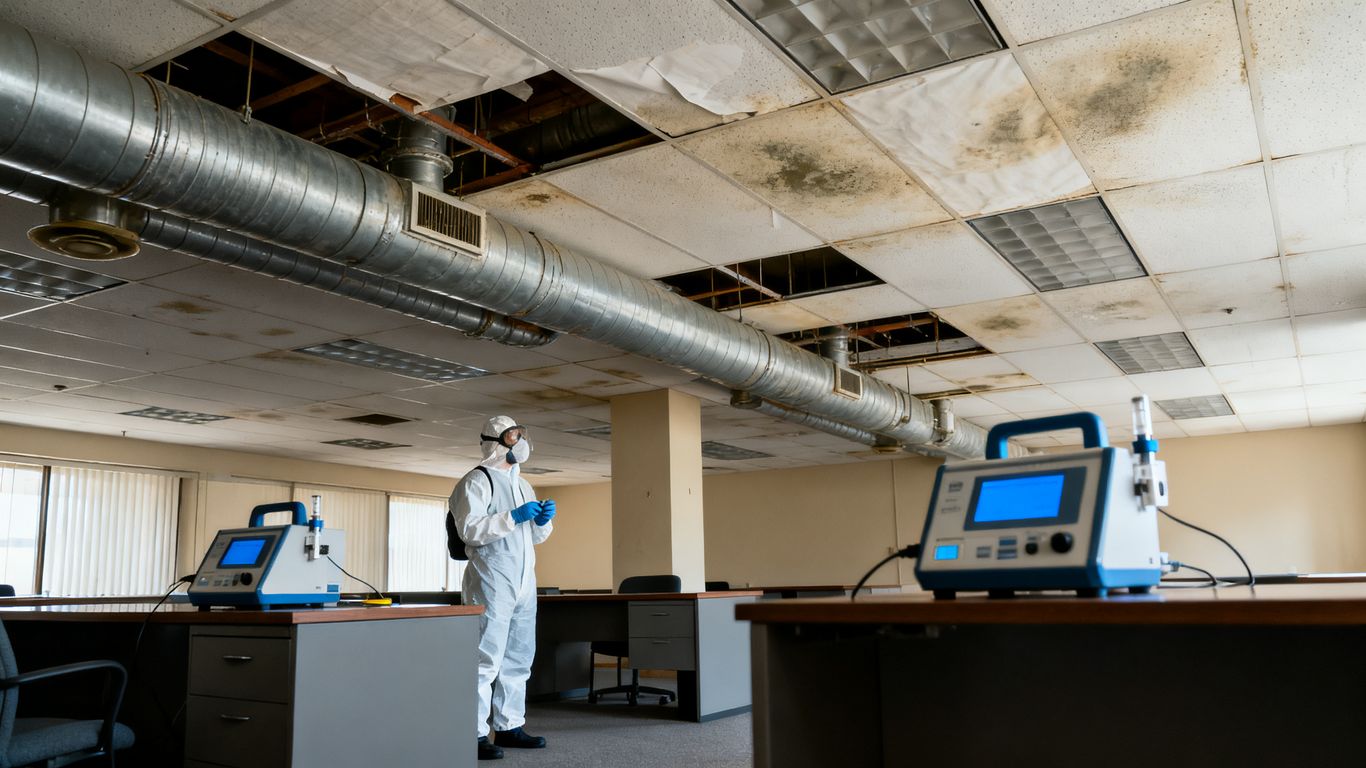
Older commercial buildings often combine aging materials, deferred maintenance, and systems designed for a different pattern of occupancy. A problem may remain concealed until renovation, a plumbing failure, or a change in ventilation exposes it. For owners and employers, commercial building health hazards are therefore a matter of history, condition, and use—not simply the year the building opened.
How aging materials and outdated systems create exposure pathways
Water can travel through roof assemblies, masonry, window joints, and plumbing chases before appearing as a stain inside an occupied room. Deteriorating insulation, damaged finishes, and settled dust can also release contaminants when materials are disturbed. Older heating and ventilation equipment may distribute pollutants unevenly, creating exposure pathways that are difficult to see from a desk or hallway.
Why hazards may remain undetected during routine occupancy
Routine occupancy does not amount to a health assessment. Many contaminants have no reliable odor or visible sign, while symptoms may be mild, intermittent, or confused with seasonal illness. A ventilation problem may become noticeable only when meeting rooms are full, and hidden moisture may remain active behind an apparently clean wall.
Occupants also adapt to gradual changes. They may open windows, move desks, or stop using a particular room without connecting those choices to the building. General indoor air quality guidance can help frame questions about ventilation, furnishings, housekeeping, and microbial contamination, but unusual or persistent conditions still require site-specific evaluation.
Building age, renovation history, and risk factors to investigate
Building age is a useful starting point, not a diagnosis. Investigators should review original construction, additions, previous abatement work, floods, roof replacements, changes in heating and cooling equipment, and renovations that may have disturbed concealed materials. A newer building can also develop serious problems if moisture control, ventilation, or maintenance has been neglected.
The most useful history connects dates with events. A complaint that began after a remodel, a leak, or a change in cleaning products may point toward a plausible source, while a pattern limited to one wing may suggest a localized system or moisture issue. Records should be compared with current conditions rather than treated as proof that a hazard is absent.
How occupant complaints can reveal underlying building problems
Complaints become more informative when they are recorded consistently. The time, location, activity, weather, symptoms, and whether conditions improve away from the building can help identify patterns without assuming a cause. A cluster of reports near a loading area, mechanical room, or recently renovated space deserves prompt attention.
No single complaint proves that a building caused an illness. Still, repeated reports should not be dismissed as subjective, especially when they coincide with odors, visible dampness, temperature problems, or ventilation failures. A respectful response protects both occupants and the integrity of the investigation.
Common indoor air quality hazards
Indoor air problems usually arise from an interaction among sources, building systems, and occupant activities. Moisture, inadequate outdoor-air exchange, chemical emissions, and combustion products can overlap in the same space. Effective control begins with finding the source and correcting the condition that allows pollutants to accumulate.
Mold and moisture intrusion behind walls, ceilings, and flooring
Mold growth can develop where water remains trapped in drywall, insulation, ceiling materials, carpet backing, or flooring assemblies. Roof leaks, pipe condensation, floods, and poorly managed humidity are common pathways. Visible growth is only part of the issue; musty odors, staining, warped materials, and recurring dampness can indicate concealed moisture.
Cleaning a visible patch without correcting the leak rarely solves the problem. Porous materials may need specialized evaluation, and demolition can spread dust if the affected area is not isolated. Building staff should document the source, extent, and duration of moisture before repair work begins.
Poor ventilation and the buildup of carbon dioxide and pollutants
Ventilation systems influence how quickly indoor-generated pollutants are diluted and removed. Blocked intakes, dirty components, failed controls, poorly balanced airflows, and overcrowded rooms can all reduce performance. Elevated carbon dioxide may suggest insufficient outdoor-air exchange, although it is not by itself a complete measure of indoor air quality.
A useful assessment considers occupancy, schedules, temperature, humidity, filtration, and pressure relationships. The office air quality resource also places ventilation alongside building design, furnishings, cleaning supplies, and polluted outdoor air as factors worth examining. Measurements are most useful when they answer a defined question about a room or system.
Volatile organic compounds from finishes, furnishings, and cleaning products
Paints, adhesives, sealants, flooring, furniture, printers, stored products, and cleaning agents can emit volatile organic compounds. Concentrations may be higher after installation, during intensive cleaning, or when ventilation is reduced. Odor can provide a helpful clue, but it does not reliably indicate either the identity or the risk of a contaminant.
Renovation planning should account for product selection, scheduling, ventilation, curing time, and separation from occupied areas. Commercial painting work can introduce both dust and chemical exposure, so a commercial painting safety guide may help owners consider low-emission products, ventilation, and protective practices. Source control is generally more dependable than masking odors with additional chemicals.
Combustion pollutants, carbon monoxide, and improperly vented equipment
Fuel-burning boilers, furnaces, water heaters, kitchen equipment, vehicles, and portable generators can produce carbon monoxide and other combustion pollutants when equipment is faulty or improperly vented. Flue problems, backdrafting, blocked exhausts, and pressure changes can move those pollutants into occupied areas. Carbon monoxide is particularly dangerous because it is colorless and odorless.
Building operators should maintain fuel-burning equipment, keep exhaust pathways clear, and use properly installed detection devices where required. Suspected carbon monoxide exposure calls for immediate movement to fresh air and emergency response rather than a wait-and-see approach. Technical testing should follow the urgent response, not delay it.
Hazardous materials found in aging building components
Some hazards are tied less to everyday air quality than to materials installed decades ago. They may remain stable when intact and undisturbed, yet become dangerous during drilling, sanding, demolition, water damage, or improper repair. The age and appearance of a component cannot reliably identify its contents.
Asbestos in insulation, flooring, roofing, and fireproofing materials
Asbestos may be present in insulation, pipe coverings, floor tiles, mastics, roofing products, sprayed fireproofing, cement materials, and other building components. The central risk often arises when fibers become airborne during maintenance or renovation. A material that looks ordinary should not be cut, scraped, or removed based on visual judgment alone.
Owners should maintain records of known or presumed materials and communicate them to workers who may disturb building components. Sampling, if needed, should be planned by qualified professionals using appropriate controls. Occupants should avoid handling damaged suspect material and report deterioration through the building’s established process.
Lead-based paint, dust, and drinking-water contamination
Lead-based paint is most concerning when it deteriorates or creates dust through friction, sanding, scraping, or renovation. Lead can also enter drinking water through plumbing components or service lines, particularly where water has remained stagnant. Children and developing fetuses are especially vulnerable, but workplace exposures can affect adults as well.
Paint condition, renovation methods, water sources, and maintenance practices should be considered together. Dry sweeping can spread settled dust, while poorly controlled work can move contamination beyond the project area. Water sampling and paint or dust assessment should be selected for the question being asked, not ordered as a substitute for understanding the building’s history.
PCBs in older lighting ballasts, sealants, and building materials
Polychlorinated biphenyls, or PCBs, may be associated with older fluorescent-lighting ballasts, certain sealants, and some legacy building materials. Leaking equipment, deterioration, heat, or renovation can change the risk profile. A ballast or sealant should not be assumed safe or hazardous solely because it is old; identification depends on the component and available records.
Maintenance teams should avoid disturbing suspect materials without a management plan. Leaks, debris, and damaged components should be isolated and evaluated, while disposal must follow applicable requirements. Renovation specifications should identify known materials before contractors begin work.
Mercury and other chemicals in legacy equipment and fixtures
Mercury may occur in older lamps, switches, thermostats, meters, and specialized equipment. Other legacy chemicals may be found in laboratory stores, maintenance products, pesticides, refrigerants, or process equipment. Breakage can create a localized release, and ordinary sweeping or vacuuming may spread contamination.
Inventory and labeling are practical safeguards. Staff should know which materials require special collection, what to do after a breakage, and whom to contact for emergency advice. Damaged legacy equipment should be secured rather than placed in ordinary waste streams without confirmation of the proper handling method.
Health effects and warning signs for building occupants
Health effects vary with the contaminant, concentration, route of exposure, duration, and individual susceptibility. The same building condition may affect one person noticeably and another hardly at all. Symptoms can be real even when an investigation has not yet established a single environmental cause.
Short-term symptoms linked to poor indoor environmental conditions
Short-term complaints may include eye, nose, or throat irritation; headache; fatigue; dizziness; cough; wheezing; congestion; nausea; or skin irritation. Symptoms that appear during occupancy and improve after leaving may provide a useful pattern, but they do not identify a particular pollutant. Heat, noise, stress, infection, and unrelated medical conditions can produce similar experiences.
Occupants should record when symptoms occur and report building observations alongside them. That information can help clinicians and investigators compare rooms, activities, and time periods. Immediate severe symptoms, breathing difficulty, confusion, or suspected poisoning require medical attention without waiting for an environmental assessment.
Long-term risks from repeated or high-level exposure
Some hazards can produce serious health effects after substantial, repeated, or prolonged exposure. Asbestos fibers, lead, certain chemicals, combustion pollutants, and biological agents each have different toxicological profiles and exposure routes. Risk cannot be estimated responsibly from the building’s age or from a symptom list alone.
The most protective response is to reduce exposure while the facts are established. That may involve stopping a task, restricting access, improving ventilation, or arranging professional sampling. Medical evaluation is particularly important when an employee has a known high-level exposure, a worsening condition, or a diagnosis that may be related to workplace conditions.
Differences between respiratory, neurological, and skin-related symptoms
Respiratory complaints often involve cough, wheeze, chest tightness, or shortness of breath, while skin effects may appear as redness, itching, dryness, or rash. Neurological-type complaints can include headache, dizziness, unusual fatigue, confusion, or difficulty concentrating. These categories overlap, and none is specific enough to identify a building contaminant by itself.
Patterns matter more than labels. A symptom limited to a task, room, or time of day may suggest an exposure pathway, whereas symptoms continuing away from work may call for a broader medical review. Occupants should avoid self-diagnosis and provide clinicians with relevant job duties, materials, timing, and known incidents.
When workplace complaints require medical or environmental evaluation
Evaluation is warranted when complaints are persistent, severe, clustered, linked to a visible building defect, or associated with a renovation, spill, leak, or combustion event. Employers should provide a clear reporting route and preserve the details rather than asking workers to resolve the matter informally. Medical care and environmental investigation can proceed in parallel.
A credible process does not promise a particular finding. It identifies what is known, what remains uncertain, and what temporary controls are sensible while uncertainty remains. That approach supports occupants without assigning blame before the evidence is available.
How to assess commercial building health hazards
Assessment should be proportionate to the suspected problem and grounded in the building’s history. A good investigation begins with records and observations, then uses targeted sampling when results will guide a decision. Broad testing without a clear purpose can produce numbers that are difficult to interpret and easy to overstate.
Reviewing construction records, maintenance logs, and renovation plans
Construction drawings, product records, inspection reports, work orders, leak histories, indoor temperature logs, and renovation plans can reveal where risk is concentrated. Records may show repeated water events, equipment failures, prior surveys, or materials that are likely to be disturbed. Interviews with maintenance staff can fill gaps that formal documents leave behind.
The review should include current and planned work. A wall that is harmless while sealed may become a concern when a contractor drills through it. Connecting the proposed task to the material history helps determine whether an assessment, notification, or specialized control plan is needed.
Conducting a visual inspection for moisture, deterioration, and ventilation problems
A visual inspection looks for staining, bubbling paint, corrosion, damaged insulation, condensation, musty odors, blocked grilles, unusual dust, and signs of poor airflow. Investigators should examine mechanical rooms, roof areas, plumbing chases, ceiling voids, and less frequently occupied spaces as well as workstations. Photographs and mapped observations make later comparisons more reliable.
Visual inspection is a screening step, not proof that a contaminant is absent. Concealed moisture, inaccessible materials, and intermittent equipment problems may require additional methods. Findings should be tied to specific rooms, components, and possible exposure routes.
Choosing when to use air, dust, water, or material sampling
Sampling is most useful when it can answer a focused question: whether a material contains a hazard, whether dust has migrated, whether water quality is affected, or whether a suspected source is influencing indoor air. The method, timing, location, and laboratory quality all affect interpretation. A single sample rarely describes an entire building.
A sampling plan should be explained before collection so that occupants understand what the results can and cannot show. Results need to be interpreted alongside building conditions, exposure duration, and applicable standards or guidance. Remediation decisions should not rest on a laboratory number stripped from its context.
Asbestos in insulation, flooring, roofing, and fireproofing materials
Asbestos may be present in insulation, pipe coverings, floor tiles, mastics, roofing products, sprayed fireproofing, cement materials, and other building components. The central risk often arises when fibers become airborne during maintenance or renovation. A material that looks ordinary should not be cut, scraped, drilled, sanded, or removed based on visual judgment alone.
Exposure to airborne asbestos fibers is associated with serious diseases including asbestosis, lung cancer, and mesothelioma. Mesothelioma is a rare cancer affecting the thin tissue that lines the chest, abdomen, and certain internal organs. Workplace exposure has historically been an important source of asbestos exposure, particularly for employees involved in construction, building maintenance, demolition, insulation, and other work that disturbed asbestos-containing materials.
One reason mesothelioma is particularly relevant to older commercial buildings is the long delay that can occur between exposure and disease. An employee may inhale asbestos fibers during a renovation or maintenance project and develop no immediate symptoms. Asbestos-related illnesses can emerge decades later, long after the worker has changed jobs or the building itself has been renovated again. The absence of short-term symptoms therefore does not establish that an uncontrolled asbestos exposure was harmless.
Owners should maintain records of known or presumed asbestos-containing materials and communicate them to employees and contractors who may disturb building components. Sampling, if needed, should be planned by qualified professionals using appropriate controls. Occupants should avoid handling damaged suspect material and report deterioration through the building’s established process.
Asbestos illustrates why long-term building hazards require a different approach from contaminants that produce immediate irritation. Mesothelioma and other asbestos-related diseases generally do not develop immediately after exposure, making prevention especially important. By the time an occupational disease is identified, reconstructing where and when exposure occurred may require looking back many years at previous workplaces, renovation projects, job duties, and building conditions.
Asbestos deserves particular attention during renovations because disturbing previously intact material can create an exposure pathway that did not exist during routine occupancy. Identifying suspect materials before demolition or invasive work begins can protect maintenance employees, contractors, tenants, and other occupants while reducing the risk that asbestos-containing dust migrates beyond the project area.
Why only qualified professionals should test suspected hazardous materials
Suspected asbestos, lead, PCBs, mercury, and unknown chemical residues can be disturbed by careless sampling. Qualified professionals understand chain of custody, representative locations, personal protection, containment, and applicable regulatory requirements. They can also distinguish a material survey from an exposure assessment, which answer different questions.
Building staff should not collect suspect material casually or send an unverified sample to a laboratory without a plan. The construction health hazards guidance is also a useful reminder that occupational health risks can be less obvious than immediate safety hazards. Professional judgment is especially important before demolition or invasive maintenance.
Remediation and risk-control strategies
Remediation should address both the contaminant and the condition that allowed exposure to occur. A response may involve cleaning, removal, enclosure, replacement, ventilation changes, or continued management, depending on the material and setting. The safest sequence is planned before workers or occupants are placed near the affected area.
Isolating affected areas before cleanup or repair work begins
Access controls, barriers, negative air arrangements where appropriate, and clear work boundaries can limit migration during cleanup. HVAC systems may need evaluation so that contaminated air or dust is not carried to unaffected rooms. Occupants should receive practical instructions about closures, alternate routes, and reporting concerns.
Isolation is not a substitute for correction. It buys time to characterize the condition and organize competent work. If barriers fail, dust spreads, or a release is suspected, the work should stop while controls are reassessed.
Removing, encapsulating, or managing hazardous materials safely
Removal is not automatically the best option for every material. Intact asbestos-containing material, lead-painted components, or other legacy materials may sometimes be enclosed, encapsulated, or managed in place under a written plan. Damaged, inaccessible, or renovation-affected material may require a different decision.
The selected method should reflect material condition, future maintenance, occupancy, and regulatory requirements. Work practices must control dust and debris, protect workers, and prevent contamination of clean areas. Clearance or post-work verification may be appropriate before normal use resumes.
Correcting leaks, ventilation failures, and other underlying causes
A mold cleanup without moisture correction is temporary, just as replacing a filter without fixing a failing air-handling system may leave indoor conditions unchanged. Repairs should address roof and plumbing leaks, drainage, condensation, humidity, outdoor-air delivery, exhaust, filtration, and equipment combustion pathways as applicable. The underlying cause should be documented when the work is complete.
Follow-up inspection helps determine whether the repair worked under normal operating conditions. Seasonal changes and occupancy patterns can reveal failures that are not visible on the day of a site visit. Maintenance staff should receive enough information to prevent the same defect from returning.
Protecting occupants during construction, abatement, and reoccupancy
Construction can create greater short-term exposure than the original defect if work is poorly controlled. Scheduling, containment, pressure control, housekeeping, worker decontamination, and communication should be coordinated before the project starts. Sensitive occupants may need temporary relocation based on the hazard and the work plan.
Reoccupancy should follow defined conditions rather than a calendar date. The owner or employer should confirm that work is complete, waste is removed, controls are functioning, and any required clearance or inspection has been performed. A concise closeout record gives occupants confidence and supports future maintenance.
Compliance and prevention for building owners and employers
Prevention depends on assigning responsibilities before a complaint or incident occurs. Owners, property managers, employers, tenants, contractors, and workers may each control different parts of the risk. The commercial property compliance guide offers a useful framework for considering responsibilities, inspections, and risk management across business premises.
Understanding workplace health and safety responsibilities
Applicable obligations depend on the hazard, jurisdiction, building use, employment relationship, and work being performed. Owners and employers should identify who controls building systems, who authorizes repairs, who informs workers, and who retains hazard records. Contractors must also receive relevant information before disturbing building materials.
Compliance should be treated as a floor rather than the entire prevention program. A building can meet a narrow requirement and still have poor communication, weak maintenance, or an unresolved moisture problem. Competent advice is appropriate when responsibilities overlap or a project involves regulated materials.
Communicating hazards and documenting corrective actions
Hazard communication should be timely, factual, and specific about what occupants need to do. Notices should explain the affected area, interim controls, expected duration, contact person, and the basis for any restrictions. Speculation about illness or blame can undermine trust and distract from the practical response.
Documentation should capture complaints, inspections, sampling plans, results, work permits, contractor qualifications, repair dates, and follow-up findings. When Crysp compliance guidance is used to organize property responsibilities, it should support the building’s own records rather than replace them. A second reference to Crysp is most useful when managers are checking inspection and risk-management procedures against their assigned duties.
Establishing inspection, maintenance, and indoor air quality programs
A prevention program can combine routine moisture checks, HVAC maintenance, filter and exhaust records, chemical inventories, construction review, and a clear complaint process. It should define triggers for additional evaluation, such as recurring dampness, unusual odors, equipment changes, or planned demolition. Program records make gradual deterioration easier to spot.
The program should be practical enough for staff to follow. Responsibilities, intervals, escalation routes, and closeout criteria need to be visible, especially in multi-tenant buildings. Crysp can be referenced as a compliance resource for organizing health and safety responsibilities, while site decisions still depend on the building’s actual conditions and applicable requirements.
Planning renovations to prevent exposure and liability risks
Renovation planning is one of the best opportunities to find hidden materials before they are disturbed. Owners should review historical records, arrange appropriate surveys, specify containment and waste controls, coordinate HVAC protection, and establish communication with tenants and workers. The plan should also account for temporary relocation and reoccupancy.
Good planning reduces surprise work stoppages and helps prevent contamination beyond the construction zone. It also creates a defensible record showing that foreseeable hazards were considered. When conditions change, the project team should pause, reassess, and revise the controls rather than proceeding under an outdated assumption.