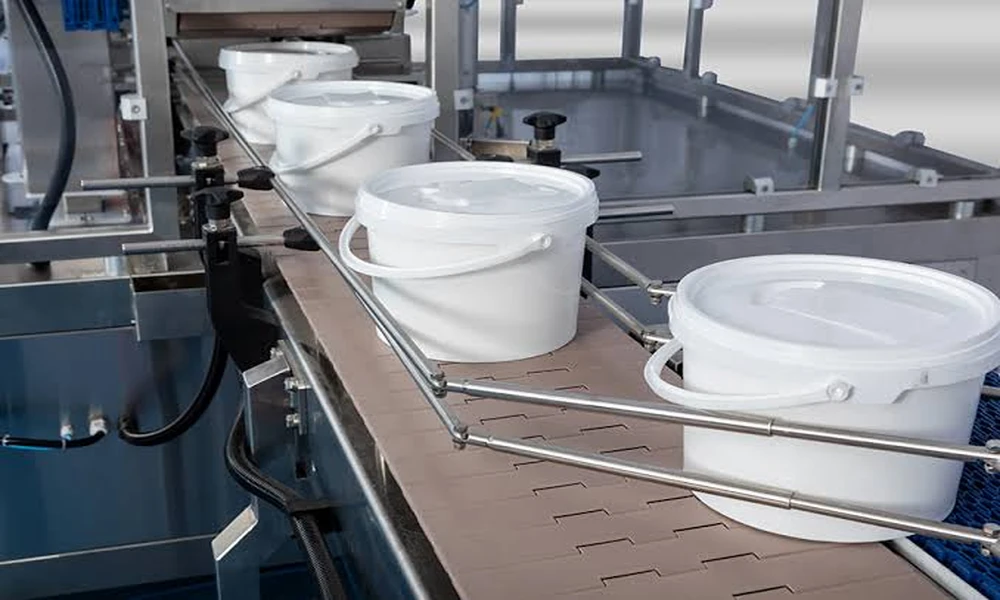
There is a station on many semi-automatic lines that nobody thinks of as equipment because it is a person. They stand at the head of the line, pull empty pails off a nested stack, and place them one at a time onto the conveyor. It is unskilled, repetitive and, on a good day, exactly fast enough. A pail denester replaces that person with a mechanism, and on a surprising number of lines it is the cheapest available increase in output.
What the Machine Does
Empty pails arrive nested inside one another to save space in transport and storage. A denester holds the stack, separates the lowest or uppermost container from the one gripping it, and places it upright onto the conveyor at the rate the line requires. Mechanisms vary: some use rotating cams or screws that engage the container rim, others use suction cups or mechanical grippers. All of them do one thing consistently that a person does inconsistently.
Why Separation Is Harder Than It Looks
Nested plastic containers grip one another, and the force required to break that grip varies with wall thickness, taper angle, how long they have been nested, temperature and even humidity. Containers that have sat in a stack for months separate differently from those unpacked yesterday. This is why denesting is a specific machine rather than a simple pusher, and why a supplier should test with your actual containers rather than assuming a nominally similar pail behaves the same way.
Where the Throughput Gain Comes From
The gain is not that a machine places pails faster in a single instance. It is that it places them at the same rate all shift, does not pause, and never becomes the reason the filler waits. On lines where an operator feeds a filler by hand, the feed rate typically sets the line speed, and it declines through the afternoon. Removing that variability frequently produces a larger improvement than an upgraded filling head would, at a fraction of the cost.
Labour Redeployed Rather Than Removed
The operator freed from feeding is usually more valuable elsewhere on the line, checking fill quality, managing lid placement or handling palletising. In most small and medium operations, denesting is not eliminating a role so much as removing the least useful use of a person’s shift. That framing also tends to make the change easier to introduce, since nobody is being replaced by the machine.
Container Consistency Matters
Automatic denesting is less tolerant of variation than a human hand. Containers that are out of round, damaged at the rim, from a different mould, or supplied with an inconsistent taper will cause misfeeds. If you buy pails from more than one supplier, or your supplier has changed tooling, this is worth raising before commissioning, because the machine will find the inconsistency that an operator has been quietly compensating for. Providers of pail handling and filling equipment should trial your actual stock.
Integration With the Line
A denester is only useful if what follows can accept containers at its rate. It feeds a conveyor with guides and a stop gate presenting pails to the filling head, and downstream capping, labelling and palletising all have to keep pace. Confirm the conveyor height matches existing equipment, that there is space for the magazine holding the stack, and that a pallet or trolley of empty containers can be brought to the machine without obstructing an aisle.
Magazine Capacity and Reloading
The practical question in daily use is how often someone has to reload the magazine. A short magazine means an operator returning every few minutes, which erodes much of the benefit. A taller magazine holds more but needs headroom and a way of lifting a stack of containers to its top. Ask how many pails the magazine holds at your container height, how reloading is done, and whether it can be topped up while the machine is running rather than requiring a stop.
Changeover Between Container Sizes
Operations running several pail sizes need to know how the machine adapts. Some designs handle a range within one setting; others require change parts or adjustment. Ask how long a size change takes, whether tools are needed, and whether settings are stored. As with most packaging equipment, changeover time frequently matters more to weekly output than nominal rate does.
Maintenance and What Wears
Denesters are mechanically simple and their wear points are predictable. Grippers, cams or suction cups contact the container on every cycle and eventually need replacing, and worn ones show up as occasional double-feeds or missed containers rather than an outright failure. Sensors detecting stack level and container presence collect dust and need cleaning. Where suction is used, the vacuum generator and filters need attention on a schedule. Ask which parts are consumable, what they cost, how often they are typically changed at your expected cycle rate, and whether they are held locally, because a machine stopped waiting for a gripper is worse than no machine at all.
Sizing the Investment
Time the current feed rate at the start and end of a shift, note how often the filler waits for a container, and count the labour committed to the task. Compare that against the equipment cost including installation and training. On lines filling in any volume, a pail denester tends to pay back faster than almost any other single item of packaging automation, precisely because it addresses a constraint most operations have stopped noticing.