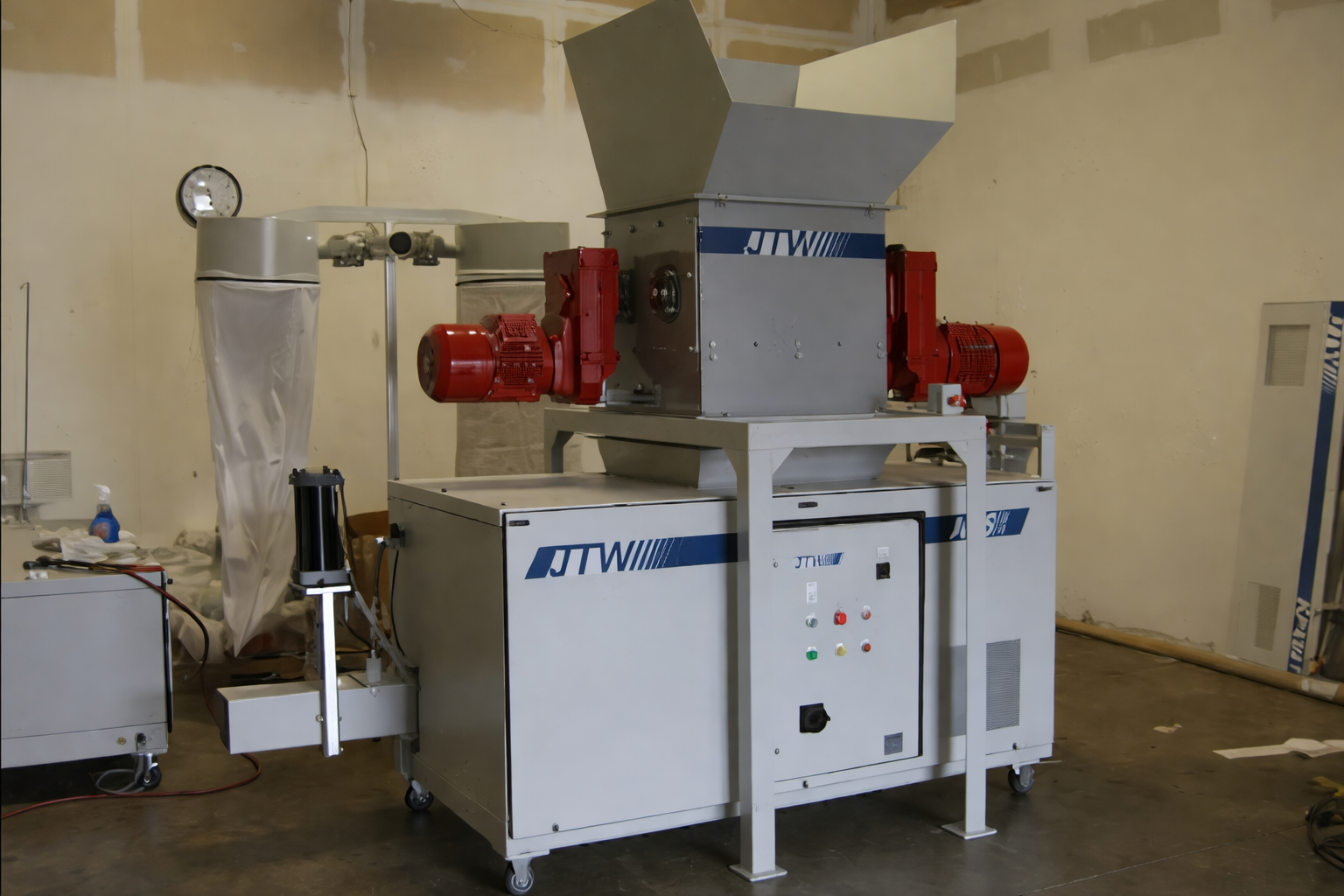
Foam and flexible plastic film protect products across manufacturing and logistics operations. Once these materials enter the scrap stream, their low density creates a persistent waste-handling challenge. Large volumes accumulate quickly, storage areas fill, and transportation becomes inefficient.
As a plastic foam densifier company, JTW sees this issue across packaging plants, extrusion lines, and recycling facilities. Many operations generate valuable recyclable material yet struggle to handle it efficiently until densification becomes part of their waste management process.
Why Foam and Film Waste Becomes an Operational Headache
Low Density Creates Logistics Inefficiency
Foam materials contain large volumes of trapped air. Expanded polystyrene often contains more than ninety-five percent air within its cellular structure. This property protects products during shipping, yet it creates severe inefficiencies once the material becomes scrap.
Loose foam fills containers quickly while adding minimal weight. Transport costs depend on container capacity rather than material density, so companies move large volumes of scrap with very little recovered value.
Facilities facing this issue often evaluate compression systems from a reliable densifier machine supplier, since densification removes trapped air and converts scrap into compact recyclable material.
Storage Pressure Inside Production Facilities
Production lines generate scrap throughout the day. Foam cutting operations, packaging assembly, and extrusion trimming all contribute to constant waste accumulation.
Common operational consequences include:
- warehouse space shifting toward scrap storage
- operators relocating waste containers during production
- production floor congestion during peak output
- housekeeping tasks increasing as scrap volume grows
These inefficiencies slowly erode operational productivity.
Labor and Waste Handling Costs
Managing scrap also requires continuous labor attention. Teams move containers, coordinate hauling schedules, and organize temporary storage areas. Although these tasks appear routine, they add operational overhead that does not support production output.
The structural differences between foam and film waste illustrate the challenge clearly.
| Material Type | Typical Waste Source | Key Handling Problem | Why Densification Helps |
| EPS Foam | Packaging inserts and molded blocks | Extremely low density | Compression removes trapped air |
| PE Foam | Protective sheets and cushioning | Bulky storage volume | Produces dense, recyclable logs |
| Plastic Film | Edge trim from extrusion lines | Lightweight but high volume | Forms rigid recyclable bricks |
When scrap volume begins to disrupt plant operations, densification becomes an effective solution.
Industries That Generate the Most Foam and Film Scrap
Many industries rely heavily on foam and flexible plastic film during production and shipping. Once these materials enter the scrap stream, their low density creates storage and transportation challenges.
| Industry | Typical Scrap Material | Operational Challenge |
| Packaging Manufacturing | EPS foam and PE foam sheets | Large scrap volumes |
| Electronics Manufacturing | Protective foam inserts | Packaging trim waste |
| Appliance Manufacturing | Molded EPS packaging | Bulky protective scrap |
| Film Production | Plastic film trim | Continuous scrap generation |
| Distribution Warehouses | Foam packaging and film wrap | Daily packaging waste |
Packaging Manufacturing
Packaging fabrication plants cut foam sheets and molded EPS blocks into protective inserts for consumer products and industrial equipment.
Common scrap sources in packaging plants include:
- Foam cutting trim: leftover material created while shaping packaging inserts
- Rejected molded pieces: packaging components that fail dimensional inspection
- Off-spec inserts: foam parts produced during machine setup or product changeovers
Expanded polystyrene contains large volumes of air, which makes transporting loose scrap inefficient. Many packaging facilities partner with a plastic foam densifier company to compress scrap into dense recyclable blocks.
Densified material offers several advantages:
- compact palletized storage
- improved transportation efficiency
- Recyclers accept the material more readily.
Electronics Manufacturing
Electronics producers rely on foam inserts to protect delicate components such as circuit boards and displays. Packaging adjustments, product redesigns, and production testing frequently generate foam scrap.
Densification systems convert irregular foam pieces into uniform logs that store easily and move efficiently through recycling channels.
Appliance Manufacturing
Large appliances require extensive molded foam packaging during shipment. Refrigerators, washing machines, and other heavy equipment rely on EPS structures that absorb shock during transport.
Manufacturing plants often accumulate large quantities of foam scrap during packaging assembly. Compression systems transform bulky pieces into stackable blocks that move through recycling logistics efficiently.
Plastic Film Production
Film extrusion operations produce trim scrap along the edges of every roll. Roll changes and off-spec runs add additional waste to the scrap stream.
Facilities often work with a film densifier company to compress flexible film scrap into rigid bricks. Densified material stores easily, ships economically, and feeds recycling processes more consistently.
Distribution and Logistics Centers
Distribution warehouses handle large volumes of packaging materials as goods move through supply chains. Foam inserts and protective film wrap accumulate rapidly during inbound and outbound processing.
Densification equipment reduces storage pressure while converting packaging scrap into recyclable material.
Recycling Facilities
Recycling centers collect foam and film scrap from local manufacturers and warehouses. Loose material remains difficult to transport economically because containers fill before reaching an efficient shipping weight.
Many recycling operations rely on equipment supplied by a film densifier company to compress scrap before transporting it to downstream recycling facilities.
How Densification Technology Converts Scrap into Recyclable Material
Densification systems remove trapped air from low-density plastic materials and compress them into compact forms suitable for transportation and recycling.
Material Collection
Production lines feed scrap into densification systems through conveyors, collection bins, or automated trim handling systems. Continuous scrap streams often enter the equipment directly from processing lines.
Air Removal and Thermal Conditioning
Foam structures contain trapped gases that prevent efficient transport. Controlled heating softens the polymer surface while allowing trapped air to escape.
Mechanical Compression
Mechanical compression applies pressure that reshapes the material into dense logs or bricks. An experienced densifier machine supplier designs equipment capable of processing various materials, including EPS foam, PE foam, EPE foam, and flexible plastic film.
Palletized Output
Compressed material exists in uniform shapes that stack easily on pallets. These blocks maintain structural stability during storage and transportation, allowing recyclers to process them efficiently.
Operational Benefits of Foam and Film Densification
Densification transforms how facilities handle low-density plastic scrap. Instead of treating foam and film as disposal problems, plants convert them into recyclable commodities.
| Operational Challenge | Result After Densification |
| Bulky scrap volume | Major volume reduction |
| Low shipping weight | Higher container efficiency |
| Storage pressure | Stackable recyclable material |
| Waste hauling costs | Reduced landfill dependency |
| Unorganized scrap flow | Controlled scrap management |
Manufacturers that collaborate with a film densifier company often discover that scrap streams represent recoverable material rather than disposal expense.
Key Considerations When Implementing Foam and Film Densification Systems
Experience across manufacturing facilities reveals several factors that determine whether densification systems operate effectively.
At JTW International, we design compression equipment for plastics processors and recycling facilities that handle significant scrap volumes. Our work as a plastic foam densifier company highlights recurring operational challenges across production environments.
Integration with Production Lines
Densification systems perform best when scrap flows directly from production equipment into compression units.
Integrated scrap handling systems provide several operational advantages:
- Direct material flow: scrap moves from production equipment into the densifier without manual handling
- Reduced labor intervention: operators avoid moving large scrap bins across the plant floor
- Consistent waste processing: steady scrap streams feed the system continuously
Consistent Processing Across Materials
Manufacturing plants frequently process several types of scrap materials. EPS foam, PE foam, and plastic film may all appear in the same facility.
Operations often rely on an experienced densifier machine supplier to design systems that maintain consistent compression performance across these materials.
Reliable Industrial Operation
Industrial environments require equipment that performs reliably during long production cycles. Durable components, stable compression mechanisms, and straightforward controls help maintain consistent operation.
Turning Foam and Film Waste into Operational Advantage
Foam and flexible plastic film remain essential materials throughout modern manufacturing and distribution systems. Their lightweight structure protects products effectively, yet it creates significant waste management challenges once these materials enter the scrap stream.
Densification technology changes this dynamic. Compression systems convert bulky waste into dense recyclable material that stores efficiently and ships economically.
Industries that partner with a specialized film densifier company often convert waste streams into operational value. Instead of absorbing disposal costs, facilities gain better logistics efficiency, improved warehouse organization, and stronger participation in recycling markets.
Frequently Asked Questions About Foam and Film Densification
What materials can densification systems process?
Industrial densification systems process several lightweight plastic materials commonly used in manufacturing and packaging, including EPS foam, PE foam, EPE foam, EPP foam, and flexible plastic film scrap.
How much can densification reduce foam waste volume?
Densification removes trapped air from foam structures and compresses the polymer material into dense blocks. Depending on the material type, compression systems may reduce scrap volume dramatically, making transportation and storage far more efficient.
Why do manufacturers densify plastic film scrap?
Plastic film trim accumulates quickly during extrusion and converting operations. Compression converts flexible scrap into rigid bricks that store easily and move efficiently through recycling logistics.
When should a manufacturing facility consider densification equipment?
Facilities often evaluate densification when scrap volume begins affecting operations. Increasing landfill costs, limited warehouse space, and inefficient recycling logistics signal the need for a solution. At that stage, many plants consult a densifier machine supplier to assess scrap streams and determine appropriate equipment.