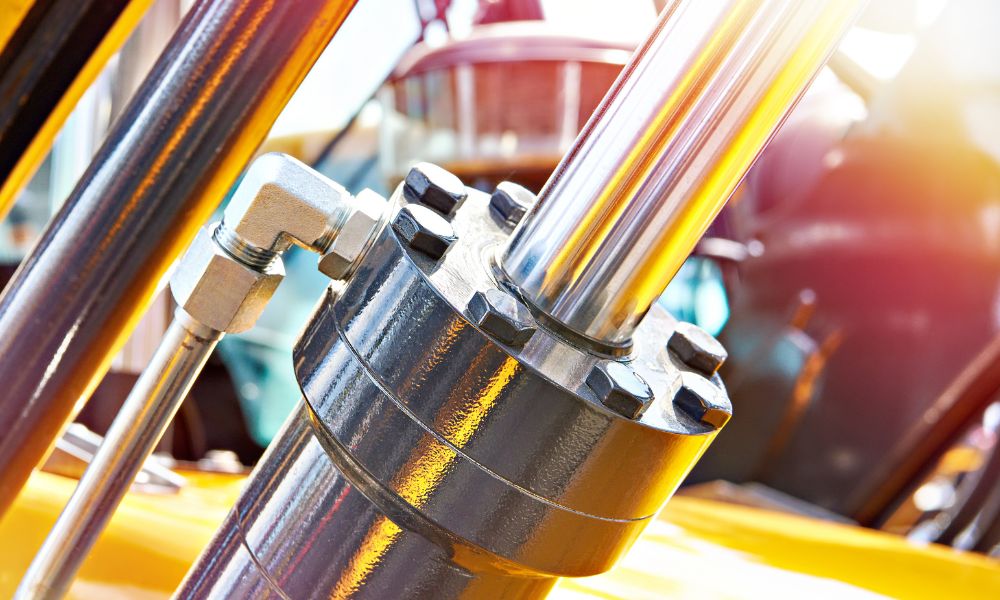
These strong force systems are used for pushing, positioning, and forming operations in different fields. They serve in almost every heavy industry, from earthmoving work to precision manufacturing. Their use shows how deeply this technology supports industrial progress. Construction and manufacturing machines rely on Hydraulic rams for their power source. As well as agriculture and material handling, they are also used in aerospace. These systems perform key motion control duties that other methods cannot match in strength or durability. They also give better control and long service life, which makes them the preferred choice for demanding tasks.
Manufacturing press operations
Metal forming presses utilise massive hydraulic cylinders generating hundreds or thousands of tons of force, shaping steel, aluminium, and other metals into automotive body panels, appliance housings, and structural components. Press cylinders measuring twelve inches or larger in bore diameter create the enormous forces required for deep drawing, stamping, and progressive die operations. The controllable force application and programmable stroke positioning make hydraulic presses superior to mechanical alternatives for complex forming operations.
- Stamping presses form sheet metal into three-dimensional shapes through controlled force
- Forging presses compress heated metal billets into precision component shapes
- Extrusion presses push material through dies, creating constant cross-section profiles
- Moulding presses close moulds under high pressure for plastic injection or composite curing
- Assembly presses insert bearings, bushings, or fasteners through controlled interference fits
Hydraulic clamp cylinders hold the mould closed under high injection pressure. The precise and quick movement of these cylinders allows fast operation and supports efficient production. Hydraulic presses in recycling units shape scrap metal or plastic into solid bales for easier transport. In manufacturing, the need for powerful force and accurate motion control is met effectively by hydraulic systems.
Material handling systems
Warehouse forklifts use mast cylinders to lift loads through vertical heights of twenty feet or more in high-bay storage facilities. The lifting capacity, ranging from two thousand to thirty thousand pounds, depends directly on cylinder bore sizes and operating pressures. Tilt cylinders adjust fork angles, preventing load shifts during transport and enabling dumping operations. Side-shift cylinders move forks laterally for precise pallet positioning without vehicle manoeuvring.
- Scissor lifts use synchronised cylinder pairs to raise platforms for maintenance access
- Dock levellers employ cylinders that bridge height differences between trucks and warehouses
- Compactor cylinders compress waste materials into collection containers
- Container tippers use cylinders, rotating bins for complete emptying
- Conveyor lifts utilise cylinders raising sections, creating inclines for elevation changes
The motion remains well controlled, and the built-in protection prevents overload during work. These hydraulic units suit heavy lifting where safety and precision hold great value. Port machines such as reach stackers and straddle carriers depend on hydraulic cylinders for all lifting and placing actions. They manage the movement of containers that travel through ports around the world. Smooth handling is possible in all conditions because of the strength of the system. Hydraulic cylinders are used in industrial fields as well as in construction and earthmoving equipment. They power machines that guide tools in farms and factories. They serve material handling units that move heavy goods and support landing gear in aircraft. These wide uses show how flexible and reliable the technology remains. The mix of strong force output, steady control, tested dependability and compact form keeps hydraulic actuation as the main choice in heavy work where accurate and powerful linear motion is needed for success.